An ESD storage box protects components between process steps. However, the wrong box quietly does the opposite. This guide shows Singapore production and stores teams how to pick the right one.
Reviewed September 2026 by the Phil Industries engineering team, Singapore. Products mentioned are stocked at 51 Ubi Ave 1 for same-day quotation.
Why an ordinary plastic box damages electronics
Standard polypropylene boxes insulate. As a result, they hold static charge on their surface. When an operator slides a PCB into one, the board can charge up. Later, the first touch to a grounded surface discharges that energy through the component. Because modern ICs fail at just a few hundred volts, this damage happens silently. Therefore, every bin, tray and tote in an EPA should use ESD-safe material instead.
Conductive, dissipative or anti-static: what the words mean
Suppliers use these terms loosely. In contrast, the standards define them by surface resistance. So here is the short version:
- Conductive — below 1 × 10⁴ ohms. Consequently, charge drains almost instantly to ground. Most black carbon-loaded boxes sit here.
- Static dissipative — between 1 × 10⁴ and 1 × 10¹¹ ohms. Charge bleeds away in a controlled way, so sensitive parts see no sudden spike.
- Insulative — above 1 × 10¹¹ ohms. In short, this is ordinary plastic and it does not belong near exposed components.
For most storage duties, a conductive ESD storage box is the safe default. However, follow your customer or ANSI/ESD S541 packaging requirements where they apply.
The main types of ESD storage box, bin and tray
Lidded boxes and totes
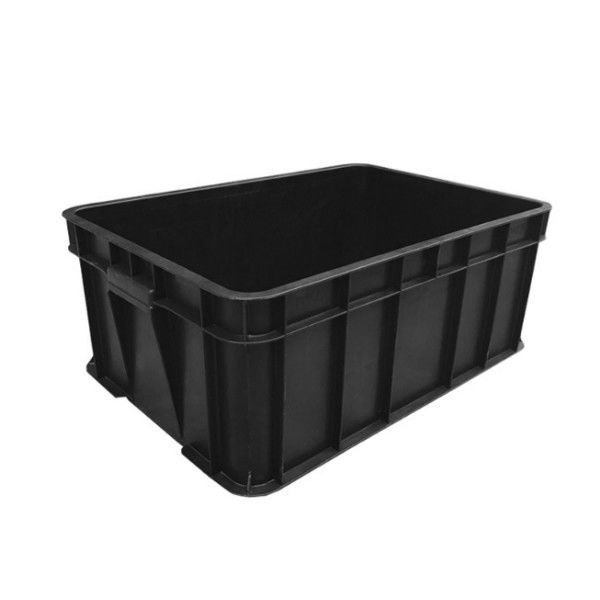
These handle general storage and transport between rooms. For example, our 600×400×230 mm black anti-static PP box stacks cleanly on racking and suits cleanroom use.
Open-front storage bins
Line-side picking works best with open bins. Similarly, our space-saving smooth-surface ESD storage bins keep small components sorted at the bench without adding static risk.
PCB trays and magazine racks
Boards need edge support and separation. Therefore, use dedicated anti-static PCB trays and ESD magazine racks rather than stacking boards in a tote.
Shipping and circulation boxes
Parts that travel between factories need tougher containers. For instance, a recyclable conductive ESD shipping box survives repeated loops while keeping contents grounded.
How to choose: a quick checklist
- First, match the box to the item. Boards go in trays, while loose components go in bins or lidded boxes.
- Second, check the material class. Conductive suits most storage, whereas dissipative suits direct component contact.
- Third, confirm the size against your racking and trolley dimensions before ordering.
- In addition, think about lids. Dust control in cleanrooms usually demands them.
- Finally, standardise on a few sizes. As a result, stacking, labelling and 5S all become easier.
Which standards matter
Two documents cover most Singapore requirements. ANSI/ESD S541 defines packaging for ESD-sensitive items, and the IEC/EN 61340 family covers protection of electronic devices more broadly. Auditors rarely ask for more than conformance to these. If your customer specifies something extra, we can check the datasheet for you before you commit.
Turnover and circulation boxes for line-side use
Storage is only half the job; parts also move between processes, and that is where a rigid conductive turnover box earns its place. Because the whole wall conducts, it grounds and shields components while they travel from assembly to test to stores, so nothing picks up a charge in transit. A stackable format such as our conductive ESD turnover box (800 × 400 × 230 mm) also saves floor space and gets reused trip after trip, which lowers packaging cost. When you standardise on one box family across storage and circulation, your whole line stays ESD-safe with less to manage. Browse the full ESD storage boxes, bins & trays range to match sizes to your parts.
Frequently asked questions
Do ESD boxes lose their protection over time?
Carbon-loaded conductive boxes keep their properties for years because the carbon sits throughout the material. In contrast, boxes with sprayed-on coatings can degrade with washing and abrasion. So check the construction before you buy.
Is an ESD storage box the same as a shielding bag?
No. A conductive box drains charge, while a shielding bag blocks external fields around a component in transit. They solve different problems, and many lines use both together. Our guide on anti-static vs static shielding bags explains the difference.
Can I mix ESD boxes with ordinary bins in the same rack?
You can, but it invites mistakes. Sooner or later someone puts a sensitive part in the wrong bin. Therefore, most EPAs standardise on black ESD containers throughout the protected area.
Stocked in Singapore, ready for quotation
We stock the full range of ESD storage boxes, bins and trays in Singapore, alongside our wider ESD packaging materials. Need a size checked or a mixed pallet quoted? Contact us at +65 6555 1745 or kenneth@phil-industries.com.sg and we respond within two business hours.