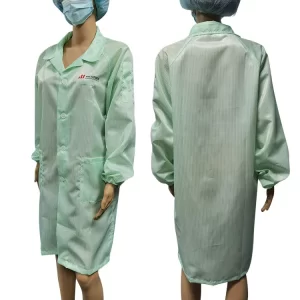
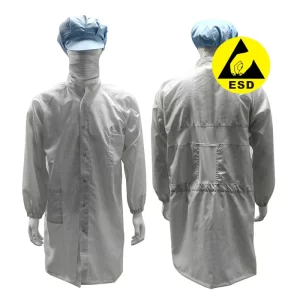
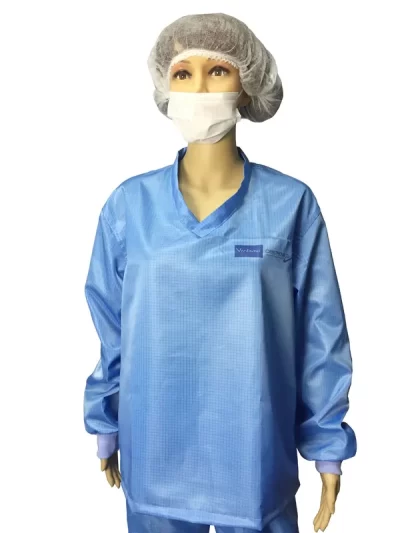
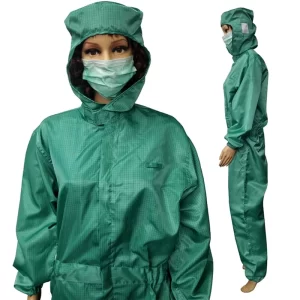
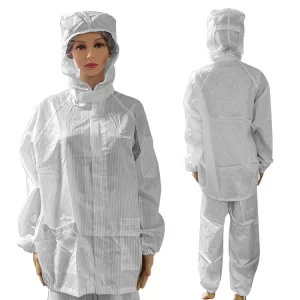
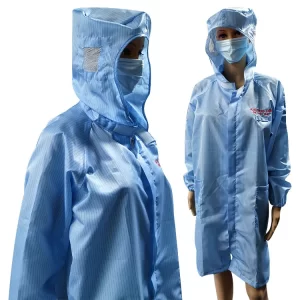
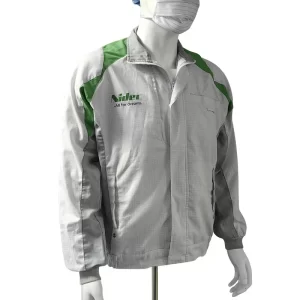
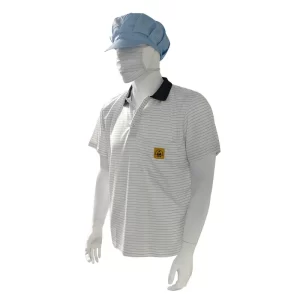
ESD safe clothing — smocks, coveralls, lab coats and cleanroom garments woven with a conductive grid that contains the charge an operator’s ordinary clothing generates. Without a garment, a polyester shirt can carry thousands of volts right up to the board. Phil Industries stocks ESD garments ex-stock in Singapore.
Garment types
| Garment | Coverage | Best for |
|---|---|---|
| ESD smock / jacket | Torso & arms | Electronics benches, general EPA |
| ESD lab coat | Torso & arms, longer | Labs, QC, inspection |
| ESD coverall | Full body | Cleanrooms, semiconductor |
| Cleanroom garments | Full body + hood/boots | ISO-classified rooms |
How ESD garments work
- Conductive grid — carbon or metal fibre woven in a grid (typically 5 mm or 10 mm) through polyester.
- Containment — the grid shields the charge generated by the clothing worn underneath.
- Groundable options — cuffs/snaps that bond the garment to the operator’s ground path.
- Durability — the grid must survive industrial laundering; wash cycles are finite.
Specifying garments
- Grid spacing — 5 mm grid for more demanding EPAs; 10 mm for general use.
- Cleanroom class — for ISO rooms, choose low-linting cleanroom-rated garments.
- Fit & closure — the garment must actually close over the operator’s clothing to contain it.
- Laundering — track wash counts; grid performance degrades over time.
Frequently asked questions
Why do operators need an ESD smock?
Ordinary clothing — especially polyester — generates and holds charge. The smock’s conductive grid contains that charge so it can’t discharge into a device.
What grid spacing should I choose?
5 mm grid gives tighter containment for demanding EPAs; 10 mm is common for general electronics work. Your S20.20 programme should specify it.
Can ESD garments be washed?
Yes, but the conductive grid degrades with laundering. Track wash cycles and re-test periodically — a worn-out smock is not an ESD control.
See also ESD Fabric, ESD Safety Shoes and Anti-Static Gloves. Call +65 6555 1745 for sizing and bulk quotes.
Related categories and guides
- Related categories: ESD Rubber Mat, ESD Packaging Materials, ESD Storage Boxes, Bins & Trays, ESD Grounding & Earthing Accessories.
- Back to ESD Products Singapore.
- Guides: ESD standards IEC 61340 and ANSI/ESD S20.20 and ISO 14644 cleanroom classes explained.