Choosing a cleanroom wiper looks simple, yet the wrong choice quietly adds contamination instead of removing it. A wiper that sheds fibres, leaves chemical residue or carries a static charge can fail your particle count long after the surface looks clean. This guide walks through how to match a wiper to your ISO class, your process and your budget, so every wipe actually improves cleanliness.
Why the wrong wiper makes contamination worse
Every wiper is judged on four hidden properties, not on how it looks. First, particle release: loose particles left on the surface. Second, fibre release: threads that break away from cut edges. Third, extractables: ions, silicones and other chemicals that leach out when the wiper meets a solvent. Fourth, sorptive capacity: how much liquid the wiper lifts and holds. A cheap wiper often scores well on price and badly on the first three, so it deposits fibres and ions onto the exact surfaces you are trying to protect. Because those defects are invisible to the eye, teams only discover them when a batch fails or a wafer yields poorly.
Cleanroom wiper materials explained
Material decides most of a wiper’s behaviour, so start there.
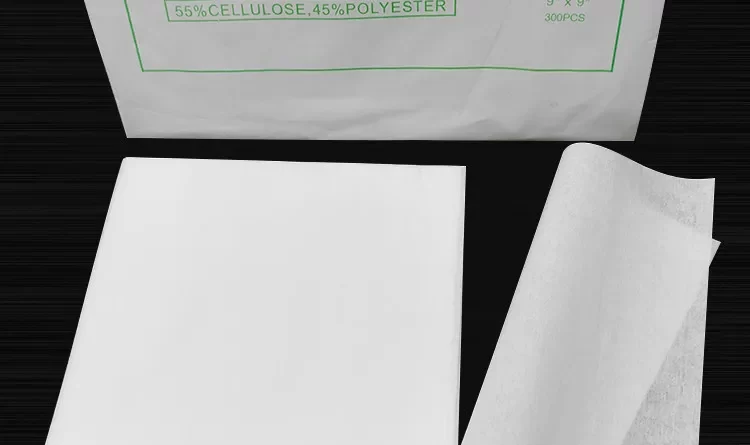
- Knitted polyester (100%): the cleanest common choice. Continuous filaments and sealed edges mean very low lint and low extractables, therefore it suits critical semiconductor, optics and medical work. Our 100% polyester cleanroom wipes sit in this class.
- Polyester–cellulose blend: more absorbent and cheaper, but it releases more particles and ions. As a result, it fits general Class 7–8 wiping, spills and tool care rather than critical surfaces.
- Microfibre (split polyester/polyamide): excellent at lifting sub-micron soils and fingerprints from optics and screens, so it works well for detail cleaning where its higher cost is justified.
- Nonwoven / meltblown: economical and disposable, therefore it earns its place in gowning rooms, less critical zones and heavy spill control.
- Foam and swabs: for narrow gaps, connectors and Class 3–5 detail work where even a knit wiper is too bulky.
Edge sealing: the detail that decides fibre release
Two identical-looking polyester wipers can shed very differently because of how their edges are finished. Laser-sealed or ultrasonically sealed edges fuse the fibres shut, so almost nothing breaks free at the border. Cut or serged edges leave raw fibre ends that migrate onto your surface. For any critical cleanroom, therefore, sealed-border wipers are worth the premium, and the datasheet should state the edge type plainly.
Matching the wiper to your ISO class
Use your cleanroom’s ISO 14644-1 class as the starting filter, then adjust for the task. The table below is a practical starting point rather than a rule for every process.
| ISO class (14644-1) | Typical wiper | Best for |
|---|---|---|
| ISO 3–5 (critical) | Sealed-edge 100% knitted polyester; sterile where required | Semiconductor, aseptic fill, optics |
| ISO 6–7 | Knitted polyester or high-grade blend | Electronics, medical device, precision assembly |
| ISO 7–8 | Polyester–cellulose blend | General wiping, spills, tool care |
| Gowning / support | Nonwoven / meltblown | Entry areas, heavy spills, low-risk tasks |
Sterile or non-sterile? When gamma matters
Sterility is a separate decision from cleanliness. A wiper can be extremely low-particle yet still carry viable micro-organisms. For aseptic fill, sterile compounding and other critical zones, choose a gamma irradiated cleanroom wipe, because the sealed pack is dosed with gamma radiation and arrives sterile. For everyday Class 4–8 cleaning, a non-sterile polyester wiper is the right, more economical fit. Match the sterility to the process risk, not to habit.
Dry wipers with IPA, or pre-saturated?
Dry wipers plus your own filtered IPA give you full control of concentration and cost, so high-volume users usually prefer them. Pre-saturated wipers, by contrast, deliver a validated, consistent solvent ratio in a sealed pack, therefore they reduce variability and VOC exposure in smaller or tightly-audited operations. Both are valid; the choice depends on volume, control and how strictly your solvent handling is regulated.
The quarter-fold technique that prevents cross-contamination
Even a perfect wiper fails if it is used wrongly. Fold the wiper into quarters and wipe with one face until it is soiled. Then unfold to a fresh face rather than reusing the dirty side, because a used face simply redistributes what it has already collected. Wipe in one direction with overlapping strokes, and never wipe back and forth over the same track. A single wiper therefore gives you up to eight clean faces before it goes into waste.
ESD-safe wipers: when anti-static properties matter
In an electrostatic-discharge protected area, an ordinary wiper can generate a charge as it drags across a surface, so it risks the very components you are cleaning. Polyester wipers used with a grounded, static-controlled process keep charge generation low. Where charge is a real hazard, pair your wiping programme with proper grounding and mats from our ESD products range, and treat the wiper as one part of a controlled system rather than a fix on its own.
How to validate a wiper before you standardise on it
Before you roll a wiper out across a facility, ask the supplier for the test report: particle and fibre counts, ions and NVR (non-volatile residue) extractables, and sorptive capacity. Then run a short in-house trial on your real surfaces and check it against your particle monitoring. Because a wiper that passes on paper can still clash with your specific solvents or surfaces, this two-step check protects you from an expensive facility-wide mistake.
Frequently asked questions
What is the most important property of a cleanroom wiper?
Low particle and fibre release for the class you run. A wiper that sheds will raise your counts, so cleanliness of the wiper itself matters more than absorbency for critical work.
Are polyester or cellulose wipers better?
Polyester is cleaner and lower in extractables, so it suits critical zones. Cellulose blends are more absorbent and cheaper, therefore they fit general, less critical tasks.
Do I need sterile wipers?
Only where the process demands it, such as aseptic fill or sterile compounding. For general cleaning, non-sterile polyester wipers are the correct and more economical choice.
How many times can I reuse a cleanroom wiper?
Treat wipers as single-use within a task. Use the quarter-fold method to get several clean faces from one wiper, then dispose of it rather than laundering on the line.
Where can I buy cleanroom wipers in Singapore?
Phil Industries stocks sterile and non-sterile cleanroom wipers in Singapore with fast quotation. Browse the cleanroom wiper range or contact us for a recommendation and a quote.
Related reading: How to stop contaminating precision components during storage and our companion cleanroom guides.