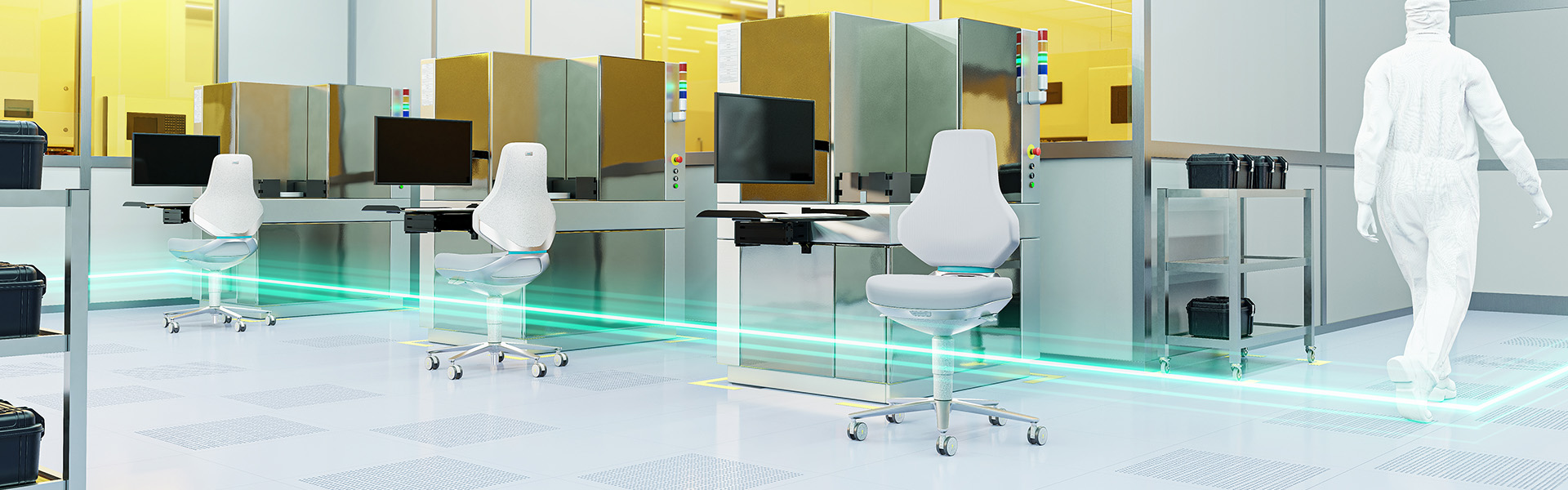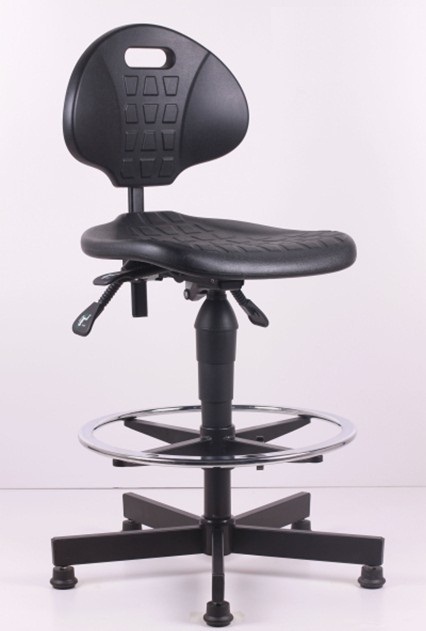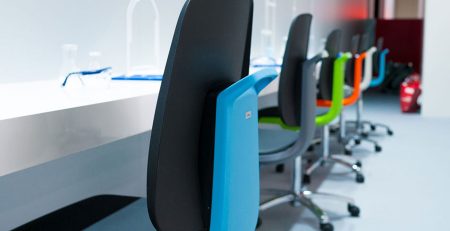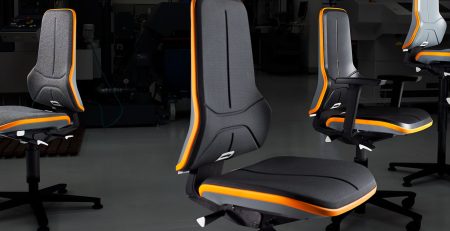
An ISO Class 5 cleanroom allows far fewer airborne particles than an ISO Class 7 room, so a Class 5 chair must shed almost no particles — sealed surfaces, cleanable frames, and sealed castors — while a Class 7 chair has more material latitude. Specifying the chair to the room’s ISO 14644-1 class is what keeps the room in spec.
ISO Class 5 vs Class 7 in Brief
Under ISO 14644-1, the lower the class number, the cleaner the room. Class 5 (roughly the old Class 100) is far stricter than Class 7 (roughly Class 10,000). That difference dictates how much a chair is allowed to contribute to the particle count.
What a Class 5 Chair Needs
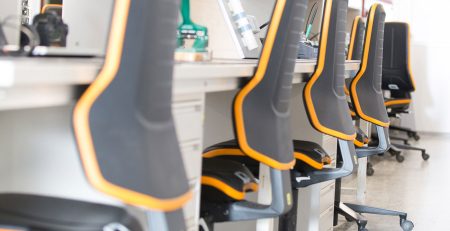
For ISO Class 5, specify seamless sealed PU or cleanroom-grade upholstery, a stainless or sealed-finish frame with minimal crevices, sealed or cleanroom castors, and low-outgassing components. ESD versions are common, since most Class 5 rooms handle sensitive electronics.
What a Class 7 Chair Needs
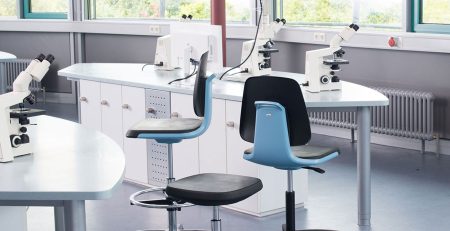
ISO Class 7 is more forgiving. Wipe-clean PU or vinyl upholstery and standard cleanroom castors are usually acceptable. You still want cleanable surfaces and no particle-shedding fabric, but the material range is wider and the cost lower.
How to Specify Correctly
Match the chair’s stated cleanroom rating to your room class, confirm upholstery and castor type, and check outgassing and cleanability. When in doubt, specify up — a Class 5 chair works in a Class 7 room, but not the reverse.
Phil Industries’ Take: How Singapore Cleanrooms Actually Spec Their Seating
Supplying Bimos cleanroom chairs to semiconductor fabs and pharmaceutical manufacturers in Singapore has taught us that the ISO class question, while important, is rarely the first specification decision. More often, the first question our clients ask is: “Does the chair have a validated particle emission test?” Bimos provides ISO 14644-1 test reports for their cleanroom ranges, and we make these available to customers on request — which simplifies the qualification process significantly.
The most common mistake we see in Singapore cleanroom fit-outs is specifying an ISO Class 7 chair for an ISO Class 5 or Class 6 area to save cost. The particle generation difference is not marginal — an unvalidated chair in a critical area can drive yield losses that exceed the cost of correct specification within weeks. For Singapore semiconductor fabs at Woodlands, Ang Mo Kio, and Tampines, we strongly recommend specifying to the room class, not one class below.
Contact Phil Industries at +65 6555 1745 for Bimos cleanroom chair specifications, test documentation, and delivery to your Singapore facility.
Frequently Asked Questions
What is the difference between ISO Class 5 and Class 7 cleanrooms?
Class 5 permits far fewer airborne particles than Class 7 (roughly old Class 100 versus Class 10,000 under ISO 14644-1), so Class 5 demands much stricter low-shedding equipment.
What chair do I need for an ISO Class 5 cleanroom?
A cleanroom-rated chair with sealed PU or cleanroom upholstery, a sealed or stainless frame, sealed castors, and low outgassing — often in an ESD-safe version.
Can one chair be used in both Class 5 and Class 7 rooms?
Yes, if it is rated for Class 5. A higher-rated (cleaner) chair works in a less strict room, but a Class 7 chair must not be used in a Class 5 room.
Spec the Right Cleanroom Chair
Phil Industries supplies Bimos cleanroom, lab and production chairs in Singapore, rated for ISO Class 5 and Class 7 environments, including ESD versions. Call +65 6555 1745 or request a quote.