The most common question when customers are setting up a new rework or inspection station: “Do I need a stereo microscope or will a magnifying lamp do?” The answer depends entirely on what the operator is doing — and the wrong choice ranges from slower output to unsalvageable rework errors.
The Core Technical Difference
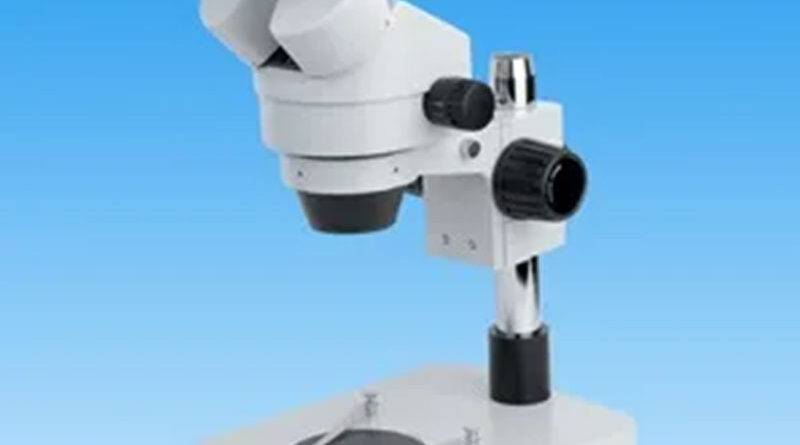
A magnifying lamp provides a magnified, flat two-dimensional image. A stereo microscope provides binocular three-dimensional depth perception. For operations involving hand tools — soldering iron, tweezers, probe tip — depth perception is not a luxury. It determines whether the tool tip goes where you intend it to go, every time.
Magnification range also differs materially: most magnifying lamps operate at 3x–5x. Stereo microscopes typically offer 7x–45x with interchangeable objectives, and digital microscopes can reach 200x for failure analysis work.
Task-to-Tool Decision Matrix
| Task | Recommended Tool | Why |
|---|---|---|
| Visual solder joint inspection, 0603 and above | Magnifying lamp (5x) | Speed; 2D sufficient for pass/fail inspection |
| Fine-pitch SMT rework, 0402 and 0201 | Stereo microscope (10x–20x) | Depth perception essential for tool placement accuracy |
| BGA inspection and reballing | Stereo microscope (20x–40x) | 3D visibility of ball alignment is critical |
| Component identification and marking | Digital microscope (50x–100x) | High magnification with camera output for records |
| Conformal coating inspection | UV-equipped scope | UV fluorescence reveals coating gaps invisible in white light |
| Wire bonding inspection | Trinocular stereo plus camera | Documentation and measurement capability required |
Working Distance: The Specification Nobody Checks
Working distance is the clearance between the objective lens and the work surface. For rework, this determines whether the operator can physically use tools under the scope. A standard stereo microscope with 100mm working distance barely accommodates a standard soldering iron tip. An extended working distance model at 150–200mm provides the clearance needed for practical rework without repositioning the scope.
If you are buying a microscope for rework rather than inspection only, always confirm the working distance — not just the magnification range. A scope with high zoom but 50mm working distance is impractical for soldering.
Lighting Selection
- Built-in LED ring light: Standard for most magnifying lamps and stereo scopes. Even, shadow-free illumination. Adequate for general inspection work.
- Gooseneck or fibre-optic lights: Directional, adjustable. Essential for revealing surface defects and solder joint geometry that flat ring illumination masks.
- UV illumination: Required for conformal coating inspection and fluorescent flux residue detection.
Phil Industries Vision and Lighting Range in Singapore
Phil Industries stocks magnifying lamps, LED ring microscope lamps, and vision systems for Singapore electronics manufacturing — available for same-week delivery from our Ubi warehouse.
Browse microscopes and vision systems and magnifying lamps, or contact our team for help specifying the right tool for your workstation task.