
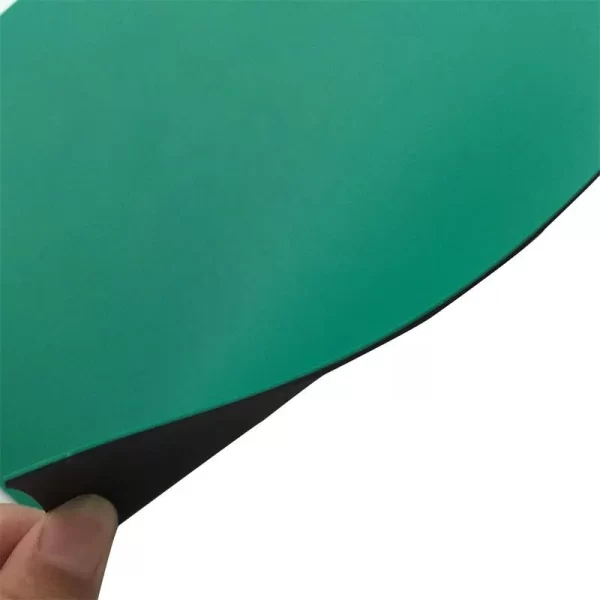
Static Dissipative ESD Rubber Floor and Table Mat
| Brand Name: | ESDpro |
| Certification: | ISO/SGS |
| Model Number: | EM0102 |
- Description
- Additional information
- Reviews (0)
Description
⚡ 10⁶–10⁹ Ω
🔥 Heat resistant
📏 2–3 mm
🥄 Solvent resistant
🇸🇬 SG supply
An anti-static rubber mat protects electronics wherever heat, chemicals or foot traffic would ruin a lighter surface. This mat bonds a static-dissipative rubber top to a conductive layer, so charge drains cleanly to ground. Because rubber resists soldering heat and solvents far better than plain vinyl, it works equally well on a rework bench or as a floor mat under a standing operator.
🧩 Rubber mat vs PVC mat — which fits your bench?
✅ Key features
- Multi-layer rubber — dissipative top over a conductive base, so static drains to ground in a controlled path.
- Surface resistance 10⁶–10⁹ Ω, therefore it dissipates charge without a damaging spark.
- Heat and solvent resistant, so it survives soldering, flux and cleaning agents.
- 2–3 mm cushioned surface that eases standing fatigue on floor installs.
- Snap grounding stud plus cut-to-length rolls, so it fits any bench or aisle.
📋 Specifications
| Material | Multi-layer anti-static rubber (dissipative top, conductive base) |
| Surface resistance | 10⁶–10⁹ Ω (static-dissipative) |
| Thickness | 2–3 mm |
| Colour | Green, blue or grey (on request) |
| Grounding | 10 mm snap stud — use with grounding cord + wrist strap |
| Resistance | Soldering heat, oils and solvents |
| Use | Bench and floor; standard sizes & cut-to-length rolls |
| Brand / Model | ESDpro (EM-series) |
| Certification | ISO / SGS |
| Availability | Singapore — stock & fast quotation |
👥 Who uses it
Soldering and rework stations choose rubber because it takes the heat. In addition, production lines, test floors and standing assembly cells use it underfoot to ground operators through ESD footwear. As a result, the same mat family covers both benches and floors across a facility.
🔗 Related: Anti-static PVC ESD table mat — the lighter bench option for general assembly.
Frequently Asked Questions
Why choose a rubber ESD mat over PVC?
Rubber resists soldering heat and solvents, so it lasts far longer at hot or chemical-heavy stations. PVC stays fine for lighter benches, therefore the choice comes down to how tough your process is.
What surface resistance does it provide?
The dissipative top measures 10⁶–10⁹ Ω. As a result, it drains charge steadily and keeps the surface ESD-safe.
Can I use it on the floor?
Yes. The cushioned rubber suits floor installs, where it grounds standing operators through ESD footwear and also eases fatigue.
How is it grounded?
You snap a grounding cord to the 10 mm stud and connect it to earth. We can supply the cord and wrist strap as a set.
Do you supply anti-static rubber mats in Singapore?
Yes. Phil Industries stocks ESDpro rubber mats and grounding hardware in Singapore with fast quotation. Call +65 6555 1745 or send an enquiry.
Related pages in Singapore
- Browse all ESD Rubber Mat.
- Learn about ESDpro, our own ESD and cleanroom brand.
- Read our guides on ESD matting for bench and floor and ESD standards IEC 61340 and ANSI/ESD S20.20.
Phil Industries, the Singapore company behind the ESDpro brand, supplies this product with selection advice and after-sales support. Call +65 6555 1745, WhatsApp +65 9853 9030 or email sales@phil-industries.com.sg.
Additional information
| ESD Classification | |
|---|---|
| Surface Resistance | 10⁶–10⁹ Ω |
Reviews
There are no reviews yet.