Last updated: 1 May 2026 | Phil Industries Singapore | Reading time: 6 minutes
ESD PU top coated anti-static gloves in Singapore are now a baseline requirement on most electronics, semiconductor, and cleanroom production lines. A single static discharge can ruin a circuit board worth thousands of dollars, so production managers across Singapore are upgrading from generic work gloves to certified dissipative gloves — a small change that delivers measurable gains in yield, operator comfort, and ESD compliance.
This guide explains what these gloves are, why a polyester liner with carbon filament construction matters, and how to choose the right pair for your facility. You can also download the full PDF version of this guide for offline reference.
What Are ESD PU Top Coated Anti-Static Gloves?
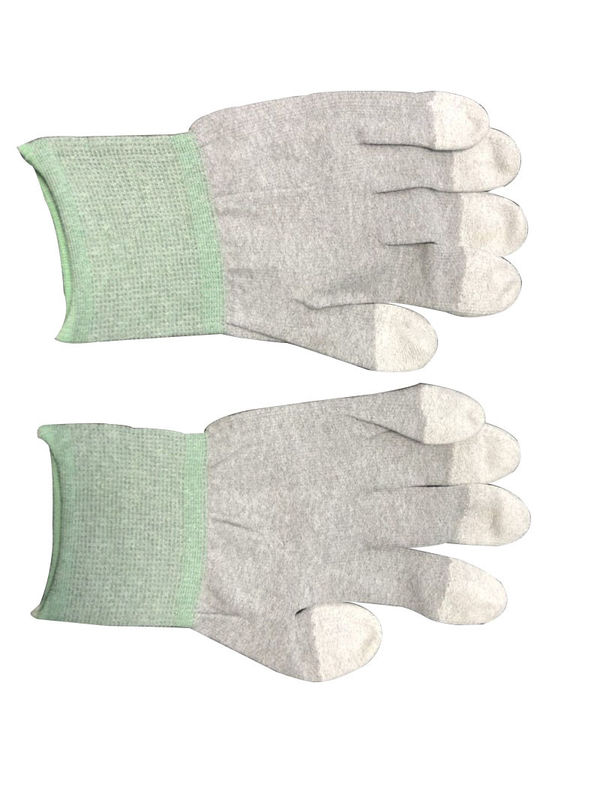
ESD PU top coated anti-static gloves are seamless knitted gloves that combine two key components. A polyester liner knitted with conductive carbon filament dissipates electrostatic charges safely to ground. This keeps surface resistivity in the controlled 10⁶–10⁸ ohm range required for ESD-protected areas (EPAs).
On top of that liner sits a polyurethane (PU) coating on the palm and fingertips. The coating gives the glove exceptional grip, abrasion resistance, and a low-particulate finish. As a result, sensitive electronics stay free of contamination during assembly.
Phil Industries supplies the AG0103 model in Singapore. It is an ISO and SGS certified glove that complies with EU standard EN388 4121, meaning verified performance against abrasion, cut, tear, and puncture. View full specifications on the official AG0103 product page.
Why Carbon Filament Polyester Liners Outperform Standard Gloves
Many low-cost “anti-static” gloves rely on topical sprays or non-conductive fibres that lose effectiveness after a few washes. By contrast, the carbon filament knitted into the AG0103 liner is permanent, washable, and continuous across the entire glove body. That gives you reliable static dissipation that stays within ESD spec wash after wash, plus a seamless palm that improves dexterity for tasks like placing SMT components. An elastic cuff also keeps the glove snug without restricting circulation during long shifts.
Key Features of the AG0103 ESD PU Coated Gloves
- Seamless knitted construction with conductive carbon yarns for uniform charge dissipation.
- Polyurethane top coating for superior grip on smooth components and abrasion resistance.
- Surface resistivity of 10⁶–10⁸ ohms, meeting ANSI/ESD S20.20 expectations for personnel gloves.
- EN388 4121 certified for mechanical protection against abrasion, cut, tear, and puncture.
- ISO and SGS certified manufacturing — Brand: allesd, Model: AG0103.
- Five sizes with colour-coded wrist bands (S–white, M–green, L–grey, XL–yellow, XXL–brown) for fast sorting on the shop floor.
- ESD logo and size printed packaging so stock rotation and audits are simple.
Where ESD PU Coated Gloves Are Used in Singapore
These gloves are a workhorse across Singapore’s manufacturing corridor. Common applications include electronics assembly and PCB handling, computer and server assembly, automotive electronics and ECU production, mechanical sub-assembly involving sensitive sensors, and quality inspection or safety checking lines where operators handle finished boards.
Does your facility run an ESD-protected area under IEC 61340-5-1 or ANSI/ESD S20.20? If so, PU top coated gloves are typically the most cost-effective hand protection that meets compliance.
How to Choose the Right Size for ESD PU Top Coated Anti-Static Gloves
Use the AG0103 size chart as a guide (tolerance ±0.3 cm):
| Size | Total Length | Wrist Colour |
|---|---|---|
| Small | 21.5 cm | White |
| Medium | 22.5 cm | Green |
| Large | 23.5 cm | Grey |
| X-Large | 24.5 cm | Yellow |
| XX-Large | 25.5 cm | Brown |
For mixed-gender production lines, most Singapore buyers stock M, L, and XL in roughly a 30/40/30 ratio.
Buying ESD Anti-Static Gloves in Singapore
When sourcing locally, look for three things: documented surface resistivity test reports, EN388 or equivalent mechanical ratings, and a supplier that can deliver consistent batch quality with fast lead times. Phil Industries supplies the AG0103 with negotiable MOQs, 7–10 working day delivery, and competitive pricing. Both one-off orders and ongoing supply contracts are supported.
📄 Download the full ESD Gloves PDF guide
Frequently Asked Questions
Are PU coated ESD gloves reusable and washable?
Yes. The carbon filament is knitted into the polyester liner, so static dissipation properties survive repeated industrial laundering when done according to ESD garment guidelines.
What is the difference between PU coated and PVC dotted ESD gloves?
PU top coated gloves give a smooth, continuous grip that is ideal for handling small electronic components without leaving marks. By contrast, PVC dotted gloves offer enhanced grip on larger or oily parts but less fine-touch sensitivity.
Do these gloves meet ANSI/ESD S20.20 requirements?
The AG0103 surface resistivity of 10⁶–10⁸ ohms falls within the dissipative range commonly accepted for personnel gloves in ESD-protected areas. Always verify with your internal ESD coordinator.
Can I order ESD PU top coated anti-static gloves in bulk for a Singapore factory?
Yes. Phil Industries supports container-level supply (150,000 pairs per 20GP) as well as smaller negotiable MOQs for local buyers.
How fast is delivery in Singapore?
Standard delivery is 7–10 working days, with T/T payment terms.
Protect Your Yield, Your People, and Your Compliance
Static damage is invisible until it shows up as a field failure. Equipping your operators with properly certified ESD PU top coated anti-static gloves is one of the lowest-cost, highest-impact upgrades you can make to your ESD program in Singapore.
Ready to source AG0103 ESD gloves in Singapore? Request a quote on the AG0103 ESD PU Top Coated Anti-Static Gloves →