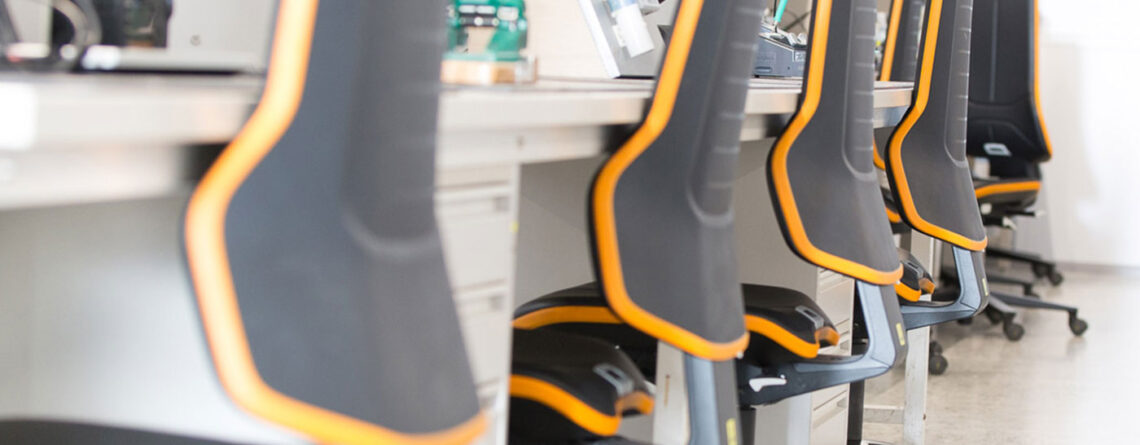
Specifying Bimos chair upholstery is one of the highest-leverage decisions in a lab fit-out. First, why it matters. Upholstery decides how the chair handles spills, IPA wipe-downs, body fluids, foam compression, and ESD continuity. As a result, the wrong choice shows up six months later as cracks, peeling, or static failures. This guide gives you the three Bimos upholstery families and the industry each one fits.
Vinyl: the affordable workhorse
Vinyl wraps a foam core in a plastic skin. Therefore, it is the cheapest cleanable surface and the most forgiving when operators eat lunch at the bench. However, vinyl cracks when it meets aggressive solvents (acetone, MEK), and it tears at the seam under heavy use. In addition, vinyl traps body heat in Singapore's climate, which becomes uncomfortable on a 10-hour shift. Therefore, vinyl is best for general production, packing lines, and low-spec QA areas.
PU integral foam: the cleanroom standard
- Single-piece moulded — no seams to leak particles. As a result, PU integral chairs pass IPA Fraunhofer cleanroom certification.
- Wipe-down friendly — tolerates daily 70% IPA, dilute bleach, and quaternary ammonium cleaners.
- Conductive variants for ESD areas with permanent surface resistance in the 106–109 Ω range.
- Comfort trade-off — firmer than fabric. Therefore, longer shifts may need a softer cushion overlay.
Supertec: the premium hybrid
Supertec is Bimos's premium upholstery. It is a microfibre-faced PU laminate that breathes like fabric but cleans like vinyl. As a result, it suits microscope stations, electron-beam labs, and long-shift QC benches where comfort matters as much as cleanability. Furthermore, Supertec is rated for 200,000 abrasion cycles under EN ISO 12947, so it survives a decade of daily seat sliding without bobbling.
Match the upholstery to the industry
For semiconductor and pharma cleanrooms, choose PU integral foam every time. For aerospace metrology and microscopy, Supertec. For general assembly, packing, and warehousing, vinyl is more than enough. In addition, hospital pathology labs increasingly choose PU integral with anti-microbial additive. Above all, never mix upholstery within a single ESD work cell — differing surface resistance can create discharge spikes.
Validation tip before you buy
First, request a 30 mm x 30 mm sample of each upholstery option from your supplier. Next, expose the sample to your routine cleaner for 30 minutes and inspect for staining, swelling, or stiffness change. Therefore, you find compatibility issues before they wreck a S$1,000 chair. For an independent reference on cleanability standards, see ISO 14644-1.
Order the right Bimos through Phil Industries
Phil Industries stocks the full Bimos cleanroom and lab chair range with all three upholstery options. For a free upholstery sample pack and on-site fit consultation, message our engineer on WhatsApp at +65 98539030 or use our contact page. In short, the right upholstery is the one that survives your chemicals, your shifts, and your auditor.