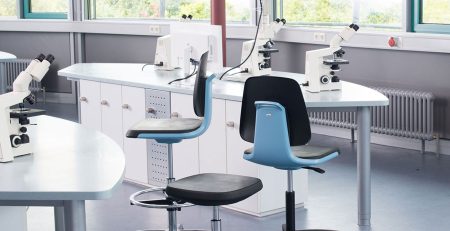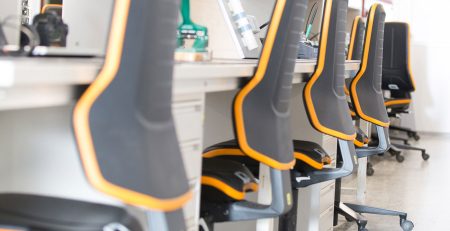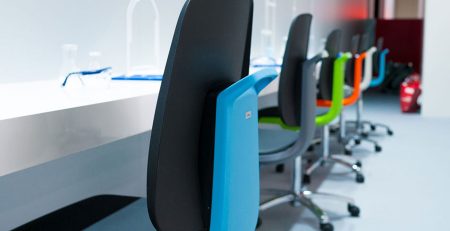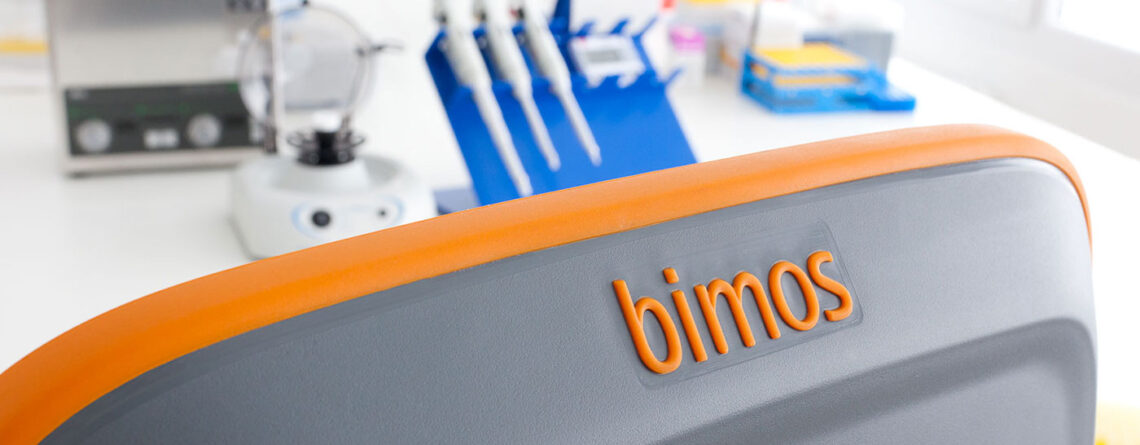
Specifying Bimos cleanroom chairs in Singapore starts with one question: which ISO 14644-1 class does the room hold? First, the short answer. ISO Class 5 (formerly Class 100) allows only 3,520 particles ≥0.5 µm per cubic metre. ISO Class 7 (formerly Class 10,000) allows 352,000 — a hundred times more. Therefore, the chair you put in each room must control particle shedding at very different levels.
Why a chair becomes a contamination source
An operator's seat is in continuous contact with garments and skin. As a result, every fibre, every flake of upholstery, and every drop of lubricant from the gas-spring can drift into the airflow. In ISO Class 5 work, even a few stray particles can scrap a wafer or a vial. Therefore, cleanroom chairs are engineered to seal everything that ordinary office chairs leave open.
Material rules for Class 5 vs Class 7
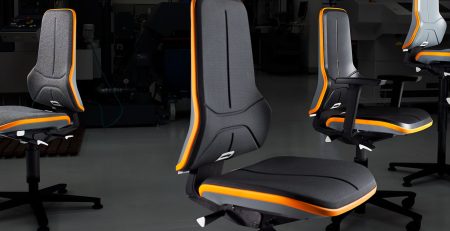
- ISO Class 5 needs Bimos models with PU integral foam (no fabric), sealed gas spring, sealed castors with stainless covers, and a particle count below 100 cycles per minute. The Bimos 9135 and 9645 series are typical fits.
- ISO Class 7 tolerates Supertec or wipe-clean PU upholstery, plus standard but cleanable castors. The Bimos 113C and 9135 trade comfort for cost while still meeting Class 7.
- Both classes need ESD-safe surfaces, a 106–109 Ω resistance path, and a removable seat cushion for autoclave or wipe-down cleaning.
The hidden spec: castor and gas-spring lubricant
Most contamination claims against cleanroom chairs trace back to the gas spring or castor lube. However, Bimos cleanroom chairs use silicone-free, low-outgassing lubricant inside sealed cartridges. Therefore, even after years of cycling, particle counts stay flat. In addition, Bimos publishes test data per IEST-RP-CC003 so QA teams can drop the numbers straight into their cleanroom validation pack.
How to validate a chair before deployment
First, verify the certificate. Every Bimos cleanroom model ships with an IPA Fraunhofer test certificate showing measured particle release. Next, wipe the chair down with the same IPA your gowning protocol uses, and inspect for streaks or upholstery damage. As a result, you confirm both cleanability and chemical resistance before the chair enters the gowning lock.
For the underlying classification numbers, see ISO 14644-1:2015.
Phil Industries can spec the right Bimos for your room
Above all, the right Bimos cleanroom chair depends on what you build. Wafer fabs, sterile pharma, and aerospace metrology each push the spec in different directions. Phil Industries supplies the full Bimos cleanroom and lab chair range, plus matching cleanroom furniture for benches and racks.
For a free spec review, message our engineer on WhatsApp at +65 98539030 or use our contact page. In short, match the chair to the class, validate the certificate, and your contamination risk drops to a rounding error.