Ergonomic Seating for Singapore Industrial Workers — Reducing Downtime & Injury
Throughout Singapore’s fast-pace industrial sectors—that range from manufacturing and logistics to precision engineering and aviation—employee health, safety, and productivity are three of the most important pillars of business success. And yet, one very fundamental but powerful factor is always ignored: ergonomic seating.
From endless production lines to high-attention inspection stations, staff spend hours slouching in stressful positions. Poor or non-ergonomic seating can lead to fatigue, musculoskeletal trauma, and reduced productivity—all of which result in costly downtime and higher injury-related claims.
This article explores the necessity of ergonomic chairs in Singaporean manufacturing workspaces and how sitting correctly reduces risk, increases productivity, and helps in compliance with workplace safety standards.
The Problem with Poor Industrial Seating
Most of Singapore’s industrial environments still use old stools, benches, or non-ergonomic fixed-height chairs for workstations. These chairs are:
- Lack lumbar support
- Non-ergonomic and fixed-height
- Encourage poor posture for long hours
- This will cause the back to ache over time:
- Lower back pain
- Repetitive strain injury (RSI)
- Reduced concentration and productivity
- High staff turnover or absenteeism
According to Singapore’s Ministry of Manpower, work-related musculoskeletal disorders (WRMSDs) are among the leading causes of work-related health issues. In manufacturing and logistics, where the majority of workers perform repetitive seated tasks, this risk is increased.
What Makes a Chair Ergonomic
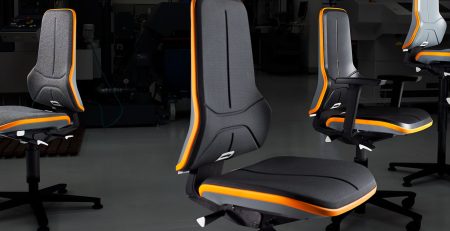
An optimal ergonomic chair accommodates the natural position of the body and relieves pressure on muscles and joints during long hours of use. In factory jobs, this is especially necessary due to repetitive motion and static positions.
The top ergonomics to find:
- Adjustable seat height: Allows people of different heights to sit flat on the floor
- Lumbar support: Preserves lower back natural curve
- Backrest tilt: Encourages movement and reduces compression of the spine
- Adjustable seat depth: Prevents pressure on the thighs and increases blood flow
- Swivel and mobility: Eliminates twisting or unnatural reaching actions
- Long-term materials: Designed for 24/7 industrial applications, including anti-fatigue and ESD-safe varieties
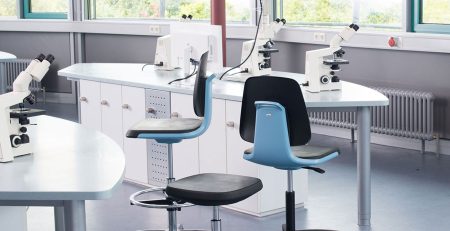
Some models feature footrings for elevated benches or sit-stand stations—prevalent in electronics, labs, and inspection rooms.
Industries That Benefit Most from Ergonomic Seating
While nearly all industries benefit from better chairs, the following industries in Singapore are most impacted:
- Industry – How Ergonomic Chairs Help
- Electronics Assembly – Improves accuracy and reduces neck strain when soldering
- Aerospace Maintenance – Reduces back strain while inspecting parts
- Pharmaceutical Laboratories – Provides comfort for extended testing and record-keeping
- Logistics & Warehouses – Facilitates mobility for inventory and packing stations
- Precision Engineering – Maintains posture for microscope or CNC applications
How Ergonomic Chairs Reduce Downtime
Injury-caused downtime isn’t just a medical issue—a monetary one as well. When employees experience neck strain, back pain, or fatigue, they’re more prone to:
- Ask for medical time off
- Function at reduced efficiency
- Make mistakes when doing manual handling or assembly
- Require costly interventions or retrofits of equipment
- Investing in ergonomic seating prevents this entirely.
For example:
- A study of workplace ergonomics published in 2022 found that there was a 25% reduction in absenteeism after chairs were upgraded.
- Organizations that had adopted certified ergonomic chairs experienced reduced lower back strain incidents and greater worker satisfaction.
Compliance for Workplace Safety in Singapore
The employers in Singapore, under Singapore’s Workplace Safety and Health (WSH) Act, need to reduce occupational health hazards. While PPE and machinery compliance are the most important concerns to most companies, ergonomics is increasingly being looked at through an audit perspective.
Employers need to:
- Perform ergonomic risk assessments
- Furnish seats that meet the ISO 9241 or other equivalent ergonomic criteria
- Train staff to use chairs correctly (adjust height, posture, etc.)
- Frequently service and check chairs to ensure continued support
- Proper sitting also aids in Productivity Solutions Grant (PSG) proposals when paired with workforce health or automation plans.
Training Staff to Use Ergonomic Chairs
The best chair is pointless without proper usage. Educate your staff on:
- Adjusting seat level so that feet remain flat and knees at 90°
- Keeping the back in supported position with lumbar contact
- Preventing slouching or forward leaning for long periods
- Breaking to stretch every 30–60 minutes
- Consider including seating arrangement in new hire onboarding or safety refresher training.
Industrial Ergonomic Chair Buying Considerations
When purchasing chairs for your Singapore operation, remember:
- Environment: Cleanroom? ESD-safe? Chemical exposure?
- Diversity of users: Will the chairs be shared across multiple shifts?
- Flooring: Will the castors be rolling on concrete, epoxy, or anti-fatigue mats?
- Budget vs. Value: Avoid low-cost chairs that are not properly certified or do not last long
Employ local suppliers who understand industrial requirements, provide test data, and ensure long-term component availability.
Conclusion
Ergonomic chairs are no luxury—they are a business necessity. For Singapore’s industrial workers, proper seating is a key element in reducing injuries, optimizing efficiency, and assuring a safe, productive workplace.
Whether you’re managing an electronics assembly line, a logistics center, or a high-tech aerospace workshop, investing in the right chair can yield returns in productivity, staff morale, and regulatory compliance.
Start by assessing your current seating and ask: Is it helping your workforce—or holding them back?